Zambia’s Monetary Policy Committee meets at a time when the macroeconomic picture is showing both signs of stability and subtle tension.
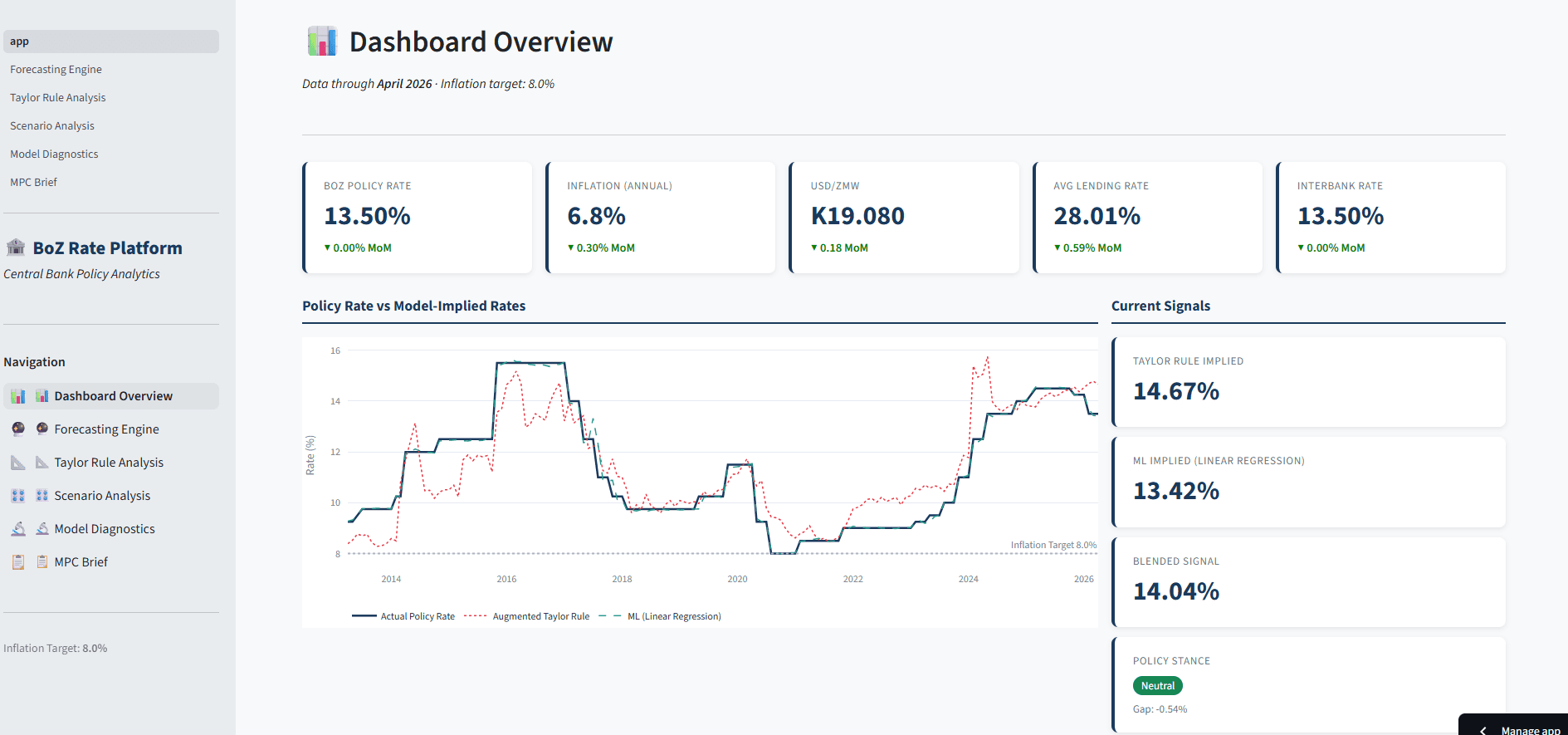
Zambia’s Monetary Policy Committee meets at a time when the macroeconomic picture is showing both signs of stability and subtle tension.
On the surface, inflation has eased. The exchange rate has shown periods of appreciation. Liquidity conditions appear contained.
But monetary policy decisions are rarely about the surface alone.
They are about direction, risk, and timing.
And this is where the data begins to tell a more nuanced story.
The Current Macro Position
The Bank of Zambia’s policy rate currently stands at 13.50%, sitting within a macroeconomic environment defined by moderating inflation and relatively tight financial conditions.
Annual inflation is recorded at 6.8%, placing it below the medium-term target of 8%. This creates an important policy dynamic: price pressures are no longer accelerating in the way they were in earlier cycles, but they are not yet fully anchored within a comfortable buffer.
At the same time, the exchange rate has been trading around K19.08 per US dollar, reflecting periods of kwacha strength that have helped ease imported inflation pressures. Broad money supply growth remains subdued, suggesting limited liquidity expansion in the broader economy. Lending conditions, however, remain tight, with average lending rates still above 28%, indicating that the transmission of monetary policy into the real economy remains restrictive.
Interbank rates are aligned closely with the policy rate, suggesting that short-term monetary policy transmission is functioning as expected.
Taken together, these indicators point to an economy that is stabilising, but not yet fully normalised.
What the Models Are Saying
When monetary policy is analysed through structured frameworks, a slightly different picture emerges.
The Taylor Rule framework, which anchors policy decisions around inflation deviations and broader macro-financial conditions, suggests a higher equilibrium policy rate of 14.67%. This reflects the model’s sensitivity to restoring inflation alignment and maintaining policy credibility over the medium term.
In contrast, machine learning models based on historical relationships in the data produce a more conservative estimate. A linear regression model suggests a policy rate closer to 13.42%, which is broadly aligned with current levels. Over a six-month horizon, the model outlook remains relatively stable at around 13.38%, indicating limited near-term pressure for major directional shifts.
When these signals are combined into a blended view, the implied policy rate sits at approximately 14.04%, creating a policy range between 13.42% and 14.67%.
This range matters more than any single number. It reflects uncertainty, model disagreement, and the real-world complexity of monetary policy transmission.
The Policy Gap in Context
Against this model-implied range, the current policy rate of 13.50% sits slightly below the blended estimate.
The resulting policy gap is modest, at approximately -0.54 percentage points, suggesting that monetary policy is broadly neutral but marginally accommodative relative to model-based equilibrium conditions.
This is not a signal of misalignment. Rather, it reflects a system in balance, where policy is neither aggressively tightening nor actively stimulating demand.
However, the Taylor Rule perspective introduces a subtle counterweight. It suggests that, under structural assumptions, policy could justify a slightly higher rate to reinforce inflation anchoring and medium-term stability.
What Is Driving the Signal
The underlying macro drivers help explain this divergence.
Inflation being below target would typically argue for a more accommodative stance. It reduces immediate pressure on the central bank to tighten.
At the same time, the appreciation of the kwacha introduces additional disinflationary effects, particularly through imported goods pricing. This strengthens short-term price stability but can also mask underlying structural pressures.
Liquidity conditions, reflected in subdued M2 growth, suggest that domestic demand is not overheating. Instead, the financial system is operating under relatively constrained conditions.
What emerges is a policy environment shaped by mixed signals: stable inflation, tight liquidity, and moderate external strength.
Interpreting the Policy Direction
Within this context, the model-based synthesis suggests a mild tightening bias relative to the current stance.
A 50 basis point increase appears within the upper bound of model expectations, particularly when weighted toward the Taylor Rule framework, which places greater emphasis on medium-term inflation stabilisation and policy credibility.
However, this is not a strong directional call. It is better understood as a calibrated adjustment signal rather than a policy requirement.
The key message is that the system is close to equilibrium, but not perfectly centred.
Risk Environment
The risk profile remains balanced, but not symmetrical.
Inflation risk is currently assessed as low, given that inflation is below target and external price pressures are contained.
Exchange rate risk remains moderate, as currency movements can quickly shift imported inflation dynamics, especially in a trade-dependent economy.
Liquidity risk is also relatively contained, reflecting weak monetary expansion and limited credit acceleration in the system.
This combination suggests that the immediate threat is not runaway inflation, but rather uncertainty in external and financial transmission channels.
Final Interpretation
The Zambian monetary policy environment at this point in the cycle reflects a transition phase rather than a directional crisis.
Inflation has eased. The currency has stabilised. Liquidity remains controlled. Yet model-based frameworks suggest that policy is slightly below the level implied by structural monetary rules.
This creates a narrow but important policy space.
The current stance can be described as broadly neutral, with a mild upward bias in model-implied equilibrium conditions.
In practical terms, this means that any policy adjustment would likely be incremental rather than aggressive, aimed more at reinforcing stability than correcting imbalance.
Ultimately, the central message is that Zambia’s monetary policy is operating within a narrow corridor of equilibrium.
Not under pressure.
Not overheating.
But watching both sides of the risk spectrum carefully.
Generated Insight
Model framework: Taylor Rule + Linear Regression + XGBoost Blended System Policy gap: -0.54pp Forecast dispersion: 13.42% – 14.67% Interpretation: Neutral stance with mild tightening bias in structural models
© 2026 Kampamba Shula